On Nov. 13, Sarasota Paradise announced that it would discontinue operations and will not take part in the 2027 USL League One season, just three weeks after playing its final home match. The club did not give a reason, saying only that it would deal directly with fans and partners who had already paid for 2027 season tickets and sponsorships. Sarasota is the third League One club to fold this offseason, following Westchester SC and Corpus Christi FC, and the fourth League One club to fold or withdraw in 2026 once Tormenta FC's preseason exit is counted.
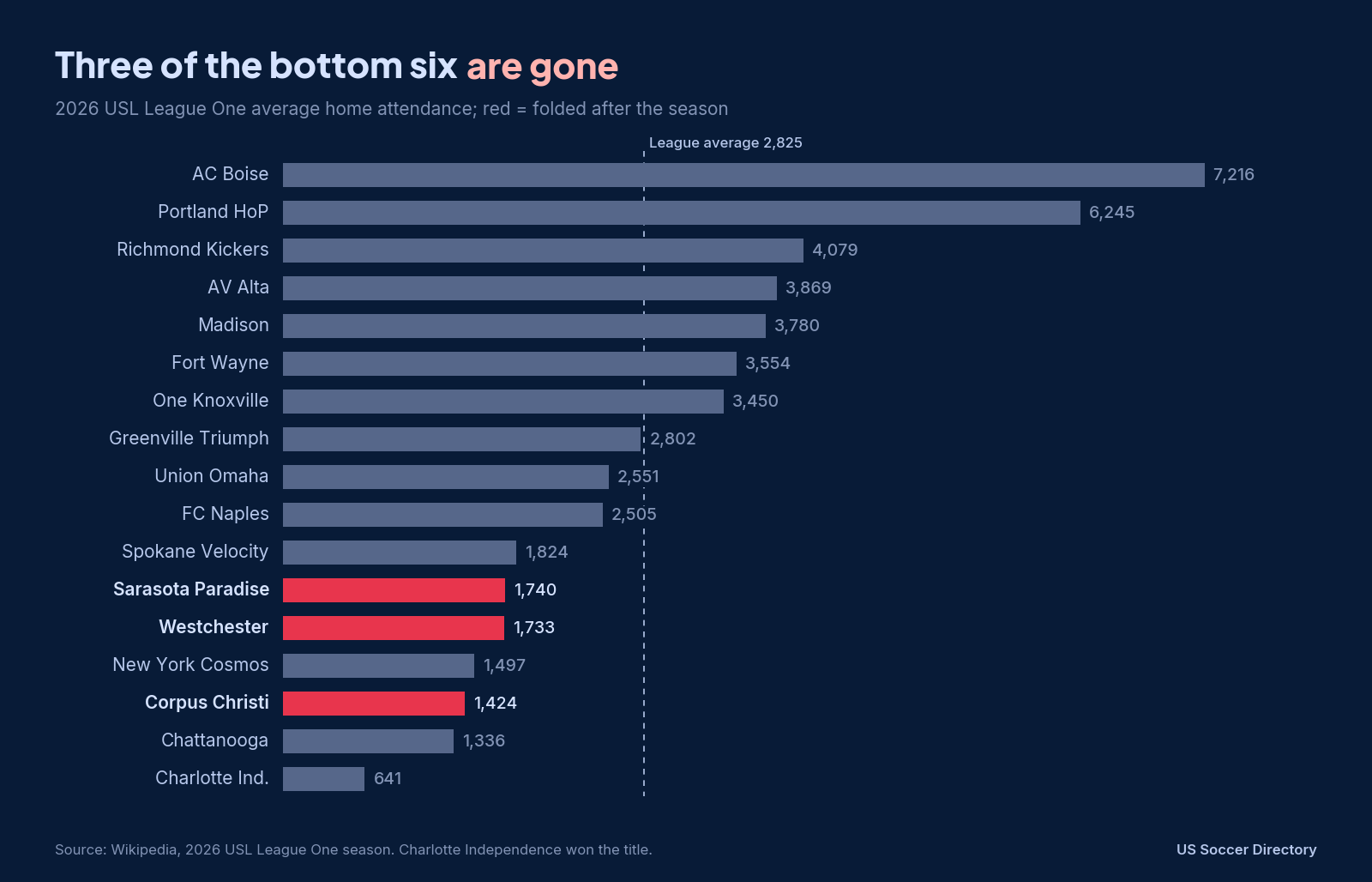
At first glance, it would be easy to file Sarasota alongside the other two as another expansion club that could not find an audience. The numbers do not really support that. Sarasota averaged 1,740 fans in its only professional season, ranking 12th of 17 League One clubs, and drew more than three clubs that are returning next year, including the league champions. Its market is one of the fastest-growing and wealthiest in the league, and attendance rose every season since the club was founded. What seems to have changed in 2026 was not the crowd but the people running the club. Below is a look at what happened, what is known about the finances, how attendance and the local market compare to the rest of League One, and what the collapse may say about the league more broadly.
What Happened
Sarasota Paradise was founded in late 2022 by Marcus Walfridson, a Swedish coach and entrepreneur who had moved to Florida a few years earlier, and played its first USL League Two season in 2023 at Sarasota High School's Charlie Cleland Stadium. By most accounts, the club was very much his project. He was its public face, he told the Business Observer that League One was the goal by 2025 or 2026, and he later said he had put six figures of his own money into the club. In August 2024, the Papanicholas family, whose construction management firm operates in Illinois and Tampa, bought a minority stake at what was described as a low-to-mid seven-figure valuation. A few months later, Manatee County approved a deal to bring the club to Premier Sports Campus in Lakewood Ranch, and in February 2025, USL announced Sarasota as a League One expansion club for 2026.
The 2026 season itself was fairly unremarkable on the field. Under head coach Mika Elovaara, hired from the Richmond Kickers the previous October, Sarasota opened with a club-record crowd of 2,791 against AC Boise in March and finished 11th at 11-14-7, out of the playoffs. Off the field, though, the club went through a major leadership change that was not made public until the season was almost over:
In July, Walfridson stepped down as CEO, staying on as a minority owner. This was not reported until Oct. 22.
On Aug. 18, the club announced a search for a president through the executive recruiting firm ZRG Partners. The job posting described a staff of about 45 people, with VP of Soccer Operations Raymond Smetanick running the club in the meantime.
On Oct. 24, Sarasota played its final match, a 2-2 draw with Westchester, which was also folding.
On Oct. 26, the Observer reported that Manatee County still wanted to sign a new five-year lease with the club.
On Nov. 12, players were told they were being released, and the club confirmed the decision the next day. Season tickets for 2027 were still on sale on the club's website at the time.
The most specific explanation so far comes from Kartik Krishnaiyer at Beyond the 90, who reported that the club had serious internal issues that were "unrelated to finances," and that its arrangement with Manatee County had created some of them. He did not go into detail, and his reporting relies on unnamed sources, so it should be treated with some caution. Backheeled added that a potential investor had contacted USL about rescuing the club, but described a 2027 return as a long shot.
Taken together, the order of events probably matters more than any one report. The person who built the club and sold it to the county left in the middle of its first professional season, and the club then spent its final three months without a president. The principal owner listed on the club's website, Marco Assis, runs a large language services company and does not appear to have been involved day to day. A club with around 45 employees, no chief executive, a lease coming up for renewal, and 2027 sales underway is in a fragile position regardless of what the balance sheet looks like. If Beyond the 90's reporting is accurate, the likeliest explanation is that ownership decided not to keep funding a loss-making club without its founder, rather than that the money simply ran out. That is an inference, though, and Walfridson's own account of why he left would go a long way toward confirming or ruling it out.
There are also a couple of loose ends around the lease. The Observer described the original county agreement as a five-year deal in January 2025, but referred to 2027 as the final year of a three-year lease in November 2026, so it is possible the terms were revised when the club went professional. Either way, the county wanted to extend as late as Oct. 26, which suggests Manatee County was not pushing the club out. If the venue was part of the problem, it was more likely the terms of the arrangement, or the lack of any route to a stadium of its own, than the county's willingness to host the team.
What the Finances Likely Looked Like
Sarasota never published any financial information, and because it was organized as a for-profit company, it does not file the nonprofit tax returns that make some lower-division clubs easier to study. What can be pieced together comes from league-wide figures and from the club's own attendance.
The reported figures give a rough sense of the cost of running a League One club:
League One expansion fees are reported at about $5 million, compared with about $20 million for the USL Championship, according to Front Office Sports. It is not public whether Sarasota paid the full fee as a club moving up from League Two.
League One's 2023 franchise disclosure document estimated total first-year investment at $7.7 million to $11.4 million, most of it the expansion fee, an annual participation fee, a letter of credit, and stadium costs.
Backheeled has estimated that a returning League One club costs roughly $2.4 million to $5.4 million a year to operate, with a debut season running considerably higher.
Manatee County paid for the locker room and stadium improvements at Premier Sports Campus.
On the revenue side, I put together a rough estimate using the club's actual attendance. Sarasota drew 27,837 fans to 16 home league matches and another 2,119 to two USL Cup home matches. At a net ticket yield of $14 to $20 per fan after discounts and complimentary tickets, that works out to roughly $420,000 to $600,000 in ticket revenue, plus perhaps $150,000 to $240,000 in net concessions and merchandise. Sponsorship is the biggest unknown. My own assumption, not a sourced benchmark, is somewhere between $500,000 and $1.5 million, with academy and camp revenue adding a bit more. That puts total revenue at roughly $1.2 million to $2.6 million.
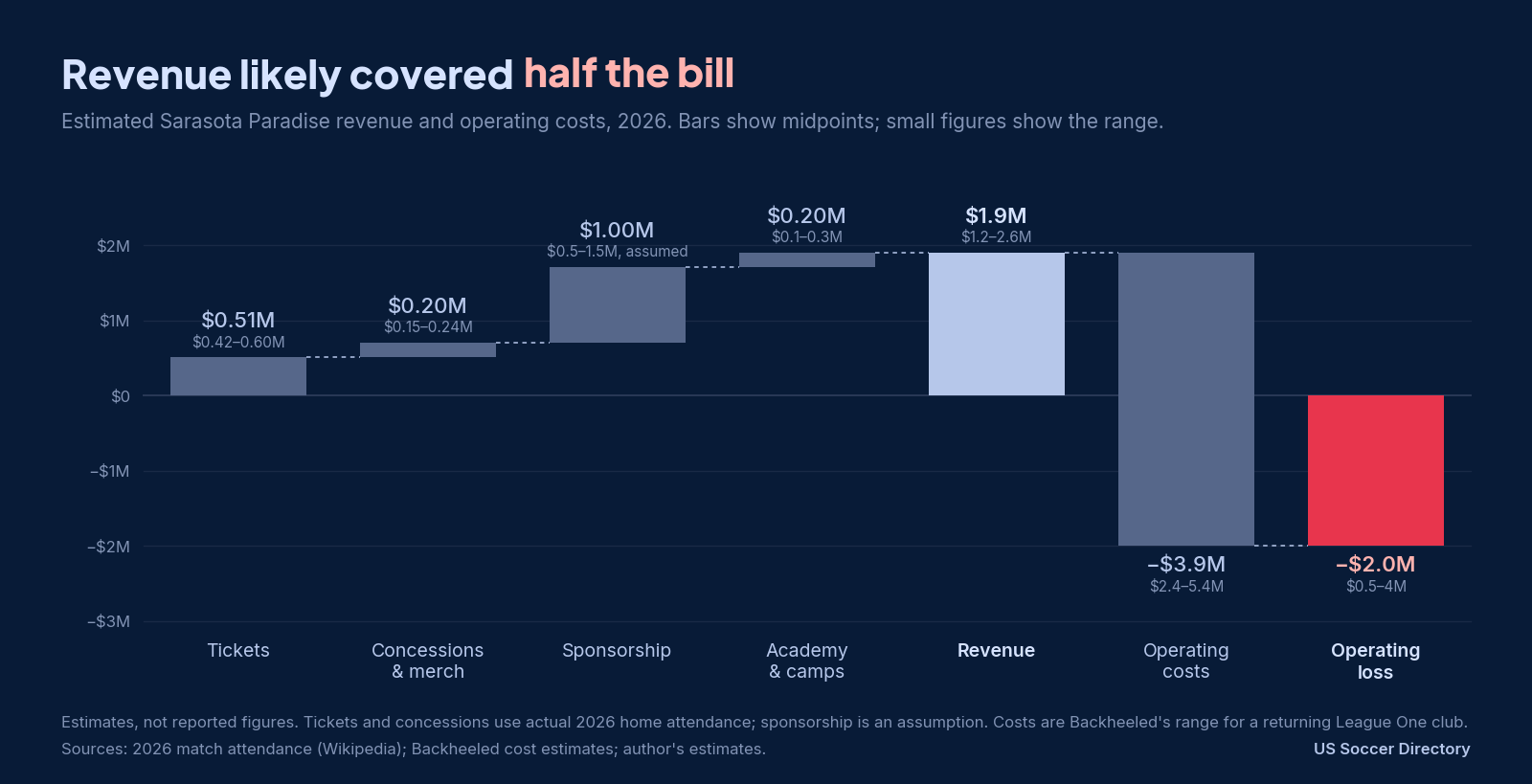
Even against the low end of Backheeled's cost range, that suggests the club was likely losing somewhere between $500,000 and $4 million a year, before accounting for the expansion fee or the higher costs of a first season. A staff of about 45 and a string of new business-side hires in 2025 and 2026 point toward the higher end of that range. The 3,000-seat venue also put a hard ceiling on what the club could earn, as selling out every league match at $20 a ticket would have brought in only about $960,000. Admittedly, losses of this size are not unusual in League One, where most clubs are believed to lose money. Whether a club survives them depends almost entirely on whether its owners are willing to keep covering them, and in July, Sarasota lost the owner who was most invested in doing so.
Attendance
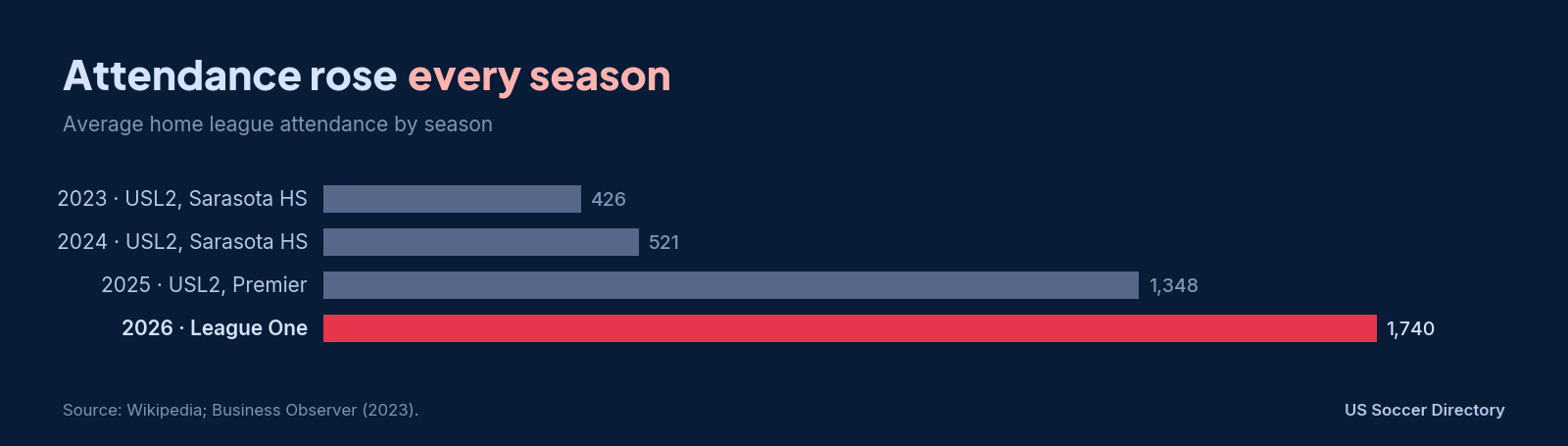
On the surface, Sarasota's attendance story is one of steady growth. The club averaged 426 fans in its first League Two season in 2023, 521 in 2024, 1,348 in 2025, and 1,740 in its first professional season. Interestingly, the largest jump came from the venue move rather than from turning professional. Moving from a high school stadium to Premier Sports Campus in 2025 increased attendance by 159%, while joining League One added only another 29%.
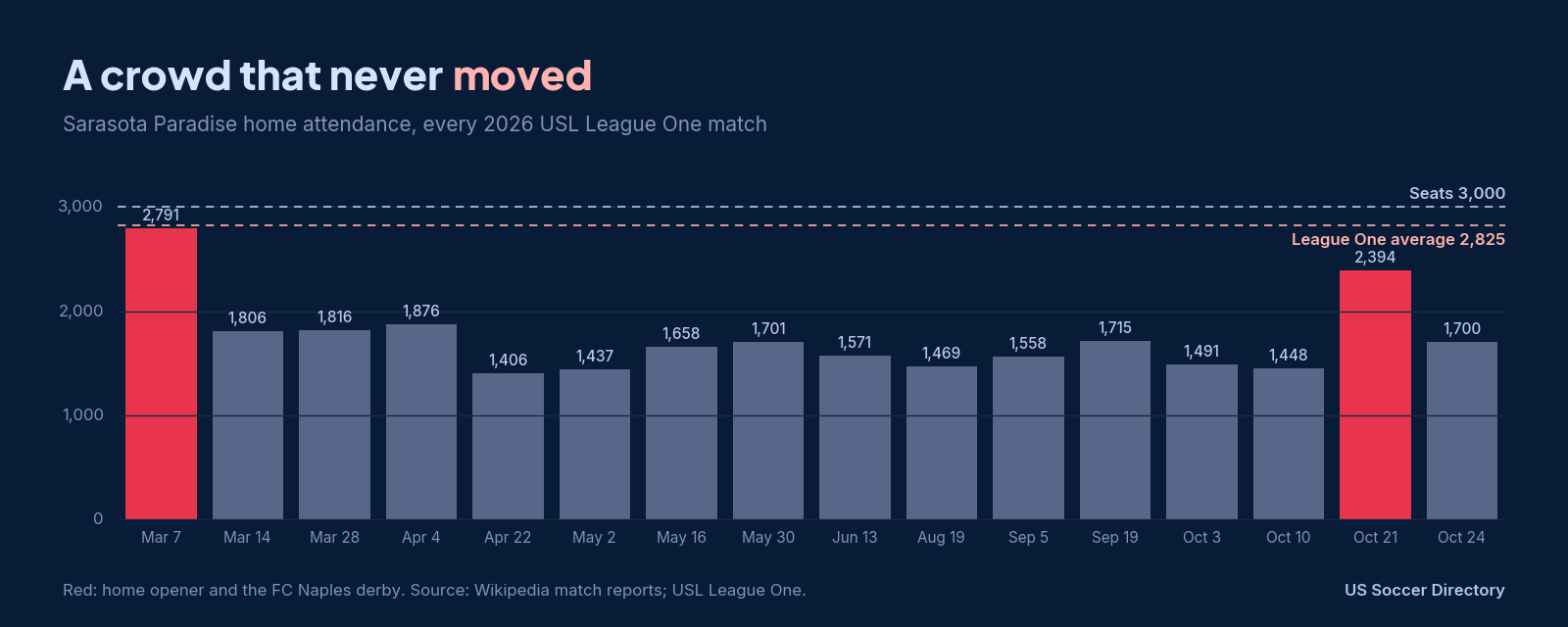
Looking at the 2026 season match by match, crowds were remarkably consistent. Outside of the home opener and the only home Florida derby against FC Naples, attendance stayed in a fairly narrow range of about 1,400 to 1,900 all season:
The 16 home league matches averaged 1,740, with a median of 1,679, filling about 58% of the venue's 3,000 seats.
Excluding the opener (2,791) and the Naples match (2,394), the average falls to 1,618.
Matches before July averaged 1,659 and matches after averaged 1,564, once the two outliers are removed, so there was neither a large novelty drop-off nor much of a late-season build.
Wednesday matches averaged 1,756, essentially the same as Saturday matches at 1,736, which suggests scheduling was not a major factor.
The two USL Cup home matches drew 683 against Sporting JAX and 1,436 against Miami FC.
Compared with the rest of the league, Sarasota sat in the lower-middle of the pack. The League One average in 2026 was 2,825, meaning Sarasota drew about 62% of it. That is clearly below where an expansion club would hope to be, but it is not the kind of number that by itself explains a club folding. Three of the bottom six clubs by attendance (Sarasota, Westchester, and Corpus Christi) have now folded, but the other three, the New York Cosmos (1,497), Chattanooga Red Wolves (1,336), and Charlotte Independence (641), are all returning. Charlotte won the league title while drawing a little over a third of Sarasota's crowds.
The Market
The local market data cuts both ways, and is probably the most interesting part of the Sarasota story. Among the 17 League One home markets, Sarasota ranks near the top on almost every measure of economic growth:
Metro population growth from 2020 to 2025 was 13.2%, the highest in League One.
Net domestic migration was 121 people per 1,000 residents from 2021 to 2025, also the highest in the league.
Per-capita income was about $94,100, the third highest.
Housing permits, job growth, and wage growth all ranked in the top three.
About 736,000 people live within 20 miles of Premier Sports Campus, and the only other professional club within about 30 miles is the Tampa Bay Rowdies.
The problem is who those residents are. Sarasota County is by far the oldest market in League One, with 38.8% of residents aged 65 or older, compared with a league median of about 18%. FC Naples' Collier County is the only other market close, at 34.8%, and Manatee County, where the venue is actually located, sits at 29.4%. Sarasota County also ranks last in League One in its share of children, its share of adults aged 18 to 44, and its birth rate, and in 2025 it recorded about twice as many deaths as births. Its median household income ranks only 10th, which suggests that much of the area's high per-capita income comes from retirement and investment income rather than local wages. Put simply, the market is wealthy and growing, but it is not full of the young families and young adults who tend to make up lower-division soccer crowds. The local economy also appears to be softening, with unemployment at 5.0% over the past year, up 1.1 points and among the worst changes in the league.
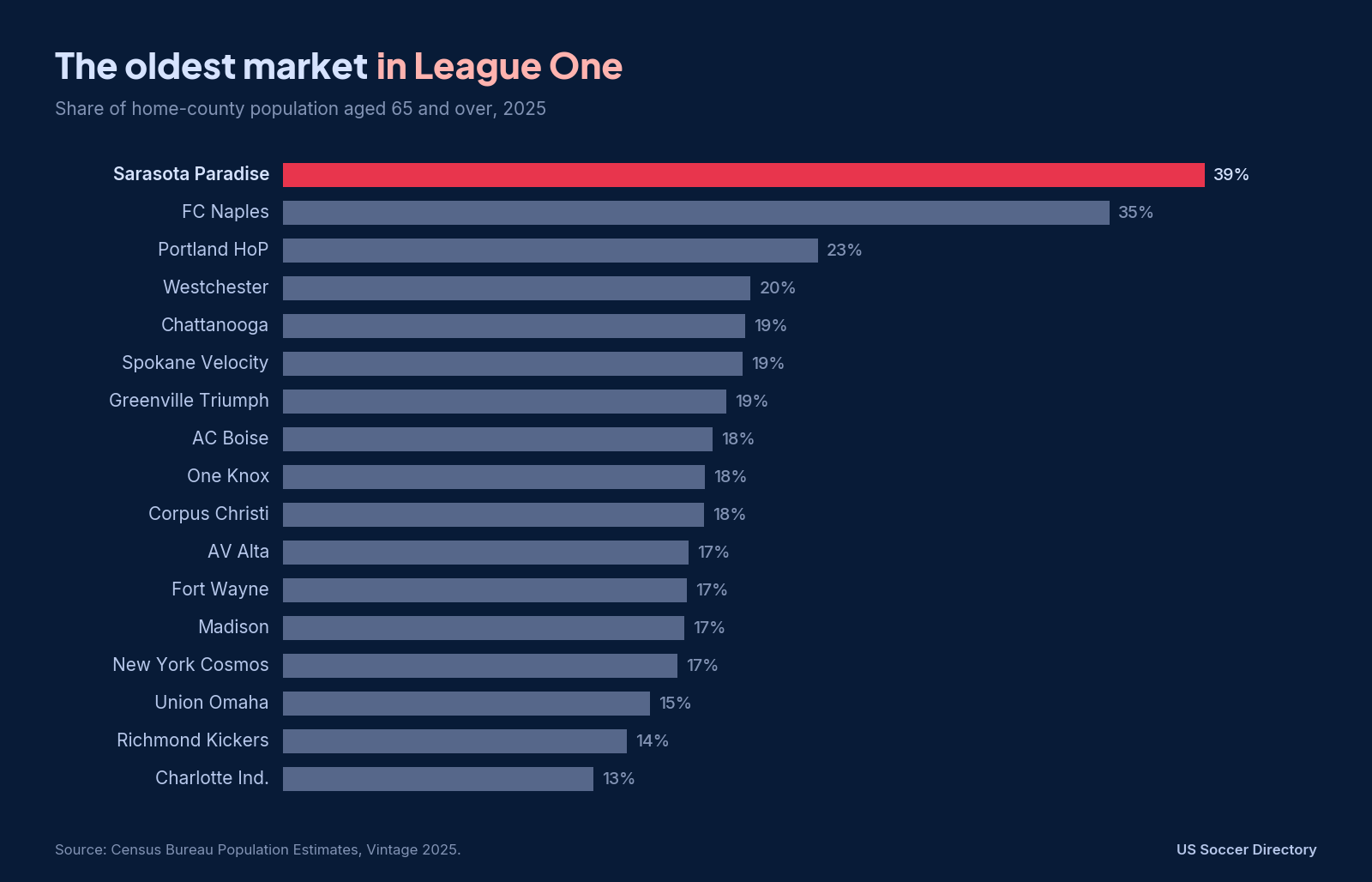
To get a sense of how much the age profile alone might cost a club, I weighted each League One county's population by how often each age group attends sporting events, using the Bureau of Labor Statistics' American Time Use Survey from 2015 to 2025. On an average day, about 2.7% of 15-to-17-year-olds attend a sporting event, compared with roughly 1% of 18-to-24-year-olds, 0.85% of adults aged 25 to 64, and 0.5% of those 65 and older. On that basis, Sarasota County's expected rate of sports attendance comes out at 93% of the League One median, the lowest in the league, just behind Naples at 94%.
That makes age a real headwind, but a fairly modest one, worth something like 7% compared with a typical League One market. It is nowhere near enough to explain why Sarasota drew 62% of the league average. Naples, with an almost identical age profile, averaged 2,505 in 2026, although that was down 28% from 3,488 in 2025. Portland Hearts of Pine, whose home county has the oldest population in League One outside of Florida, averaged 6,245, second in the league. The rest of Sarasota's gap probably comes down to the venue, the brand being new, and a March to October season that largely misses the area's seasonal residents, who tend to leave in the spring.
The Venue
Premier Sports Campus is a 140-acre youth tournament complex with 23 grass fields, owned and operated by Manatee County. The stadium field has about 3,000 grandstand seats, or about 3,260 including hospitality, and for 2026 the club added portable seat backs, tents, a container concession stand, and a video board. The venue clearly helped the club grow, offering grass, alcohol sales, and a county landlord that paid for upgrades and wanted to keep the team.
With that being said, it also had real limits for a club with professional ambitions. Sarasota was a tenant on a multi-use campus the county is actively building out with other projects, the county took a share of signage and naming revenue, premium seating was temporary, and the 3,000-seat ceiling sits far below the 15,000 seats USL Premier will require when it launches in 2028. In February, Walfridson told the Observer he hoped to have a new stadium within five years, likely through a public-private partnership, but acknowledged that Lakewood Ranch was nearly built out. In the readiness analysis I put together earlier this fall for USL Premier, Sarasota actually landed in the middle of the League One pack, but it had no stadium plan and, like most of the league, no realistic route to a Division One venue.
League Context
Sarasota's exit is part of a broader contraction in League One. Tormenta FC withdrew two weeks before the 2026 season, Westchester and Corpus Christi were announced as departures after USL's September board of governors meeting, and AC Boise is moving up to the Championship. Before this offseason, The Guardian counted 25 independent clubs that had joined League One since 2018, five of which folded or went on hiatus within three years. Including this offseason's exits, the writers at Cosmos Country put that figure at eight of 25, or roughly one in three.
Beyond the 90 has also reported that USL appears willing to let clubs that cannot meet rising financial and facility standards go, as it prepares for USL Premier and promotion and relegation. That makes some sense from the league's perspective. Expansion fees go to the league rather than to existing clubs, and a market like Sarasota, with no stadium path and a small venue, does not fit neatly into USL's long-term plans. Florida will also not be short on clubs, as Fort Lauderdale United and Port St. Lucie join League One in 2027, alongside the Rowdies, FC Naples, Sporting JAX, and Miami FC.
What It Means
The main lesson from Sarasota is probably that attendance is a weak predictor of which lower-division clubs survive. A club drawing 641 fans won the League One title and will return in 2027, while a club drawing 1,740 in one of the fastest-growing markets in the country is gone. The more important variable appears to be ownership, and specifically whether someone is willing to keep absorbing losses that are normal at this level. Sarasota was in many ways a founder's project funded by others, and when the founder stepped back, there does not appear to have been anyone ready to take over. The venue, which helped the club grow from about 500 fans to about 1,700, also gave it little control over its revenue and no clear path to something bigger.
There are still a few open questions that should become clearer over the coming months. Manatee County's lease records would show the actual terms of the arrangement and whether they changed when the club turned professional, and Walfridson's own account of why he left in July would fill in the biggest gap in the story. It will also be worth watching whether the potential rescue investor reported by Backheeled acquires the club's place in the league, and how quickly 2027 season ticket and sponsorship payments are refunded. Beyond the 90 expects a League Two side to return to the area, and given that Sarasota grew from about 400 fans to more than 1,700 in four years, there appears to be a real audience for soccer on the Gulf Coast. The next club to try may simply need an ownership group built to outlast its founder.
Click here if you would prefer to read or subscribe on Substack.
Sources
Sarasota Paradise to fold after one season (Observer, Nov. 13, 2026)
Sarasota Paradise announces closure (Pulse of Manatee)
Sarasota Paradise becomes third League One club to fold this offseason (Backheeled)
Why the Sarasota Paradise are disappearing and League One contractions notebook (Beyond the 90)
Three down in one offseason (Cosmos Country)
Westchester SC and Corpus Christi FC to exit League One (League One Updater)
Walfridson Q&A, Lakewood Ranch home, and Premier Sports Campus move (Observer)
Soccer entrepreneur aims to build off debut season and family buys interest in Sarasota soccer team (Business Observer)
Papanicholas family purchases interest in team (SRQ Magazine)
Premier Sports Campus announced as home field (Bradenton Magazine)
The stadium off Post Boulevard (Tyler Hahne)
Elovaara hired as head coach (Sarasota Herald-Tribune via Yahoo)
President search and About (Sarasota Paradise), President job posting (ZRG Partners)
Brooklyn expansion extends USL's rise (Front Office Sports)
USL League One 2023 franchise disclosure document (FDD Exchange)
2026 Sarasota Paradise season and 2026 USL League One season (Wikipedia)
Market data: US Census Bureau population estimates (Vintage 2025) and American Community Survey (2024 5-year), Bureau of Economic Analysis, Bureau of Labor Statistics (LAUS, QCEW, and American Time Use Survey 2015-2025), Census building permits, and IRS migration data