Over the weekend, reports began to emerge that Corpus Christi FC and Westchester SC would both cease operations following the 2027 USL League One season. Neither club nor the league has officially announced the moves, but the reporting appears credible. The Exchange, among other outlets, has cited USL League One officials confirming that both clubs are set to fold.
The news would bring remarkably short professional runs for two clubs that are not obviously failing on the field. Corpus Christi turned professional only this season and currently sits ninth in the table while playing in a temporary venue as its permanent stadium is built. Westchester finished last in its inaugural season but has improved to a midtable position of 11th this year, despite playing in the league’s smallest stadium, with a capacity of just 3,900. There is rarely one simple explanation for why a lower-division soccer club folds, particularly this early in its existence, but several characteristics of these two markets may help explain why Corpus Christi and Westchester struggled to establish sustainable operations.
Corpus Christi FC
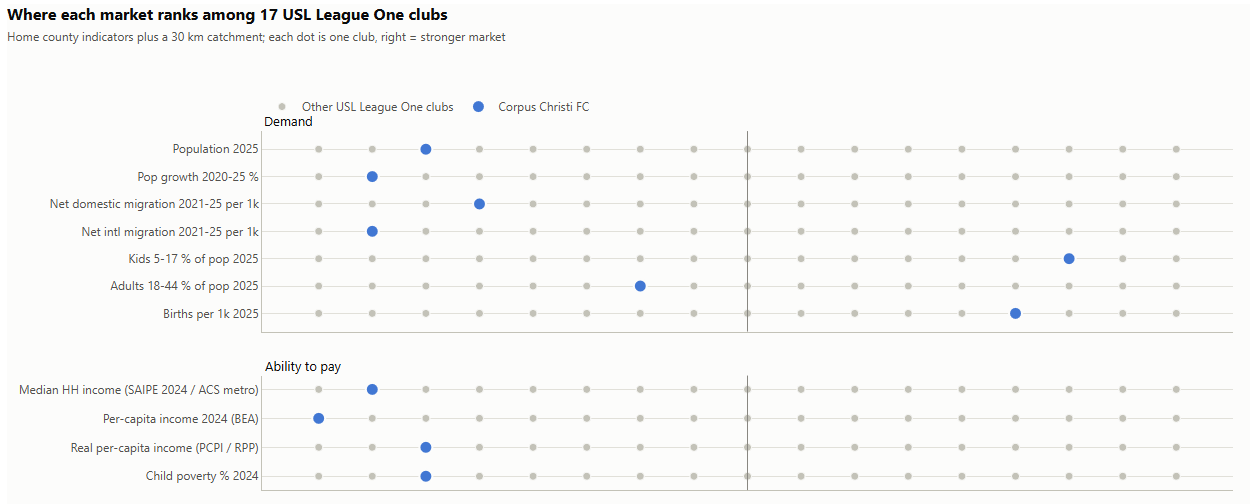
Corpus Christi appears to face the most difficult combination of household finances and market size in USL League One. Local prices are roughly 7% below the national average, but even after accounting for that lower cost of living, the market ranks 15th of the league’s 17 clubs in income. Its home-market population also ranks 15th, while population growth ranks 16th and is slightly negative at -0.2%. The broader county economy offers little help, with more residents moving out than moving in and employment growth hovering near zero. Changes in immigration policy may have created an additional headwind for population and economic growth across South Texas, although that effect is difficult to isolate from the market’s longer-running stagnation.
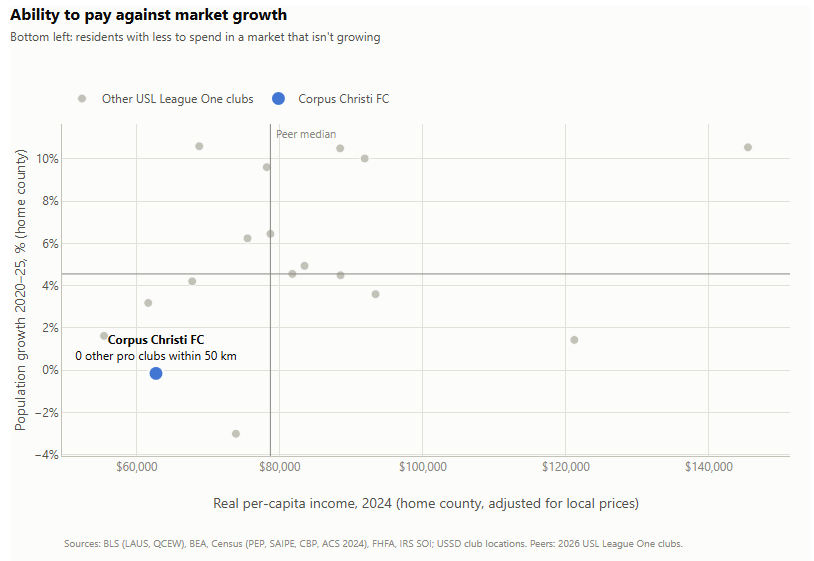
The commercial base is similarly limited. Corpus Christi has the fewest businesses per capita of any market in the league and ranks near the bottom in sports-instruction businesses and fitness and recreation centers. Those measures do not determine whether a club can survive, but they provide a useful indication of the number of local companies positioned to buy sponsorships, organize group outings, or form commercial partnerships. For a lower-division team that cannot rely on media-rights revenue, the thinnest potential sponsor base in the league leaves considerably less room to compensate for weak ticket sales.
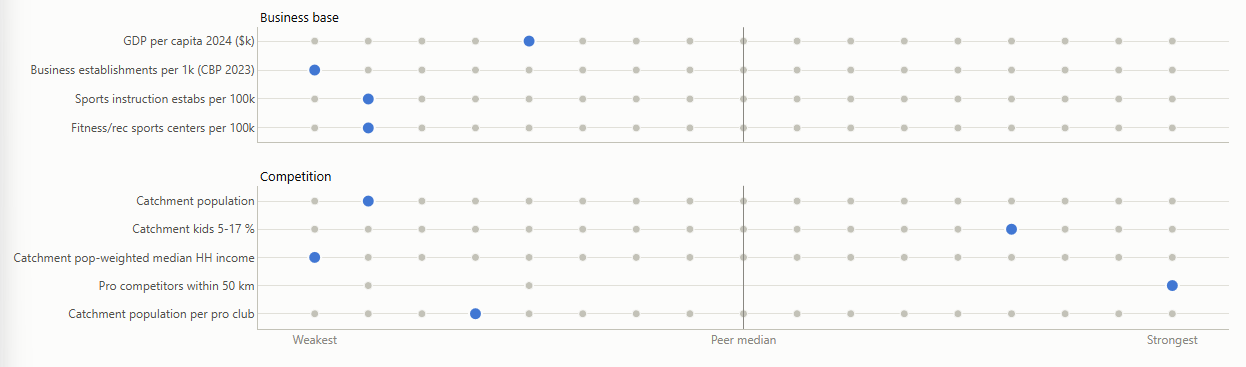
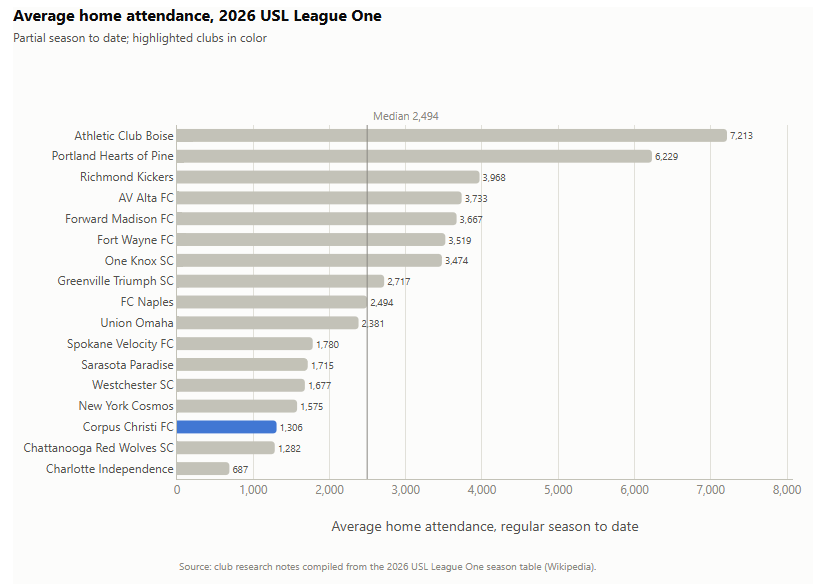
That does not mean Corpus Christi lacks a plausible audience for professional soccer. The market ranks third in its share of children aged 5 to 17 and fourth in birth rate, 62% of the population is Hispanic, and there is no competing professional sports club within 50 kilometers. Those characteristics point toward a young, culturally receptive, and relatively uncontested fan base. The problem appears to be converting that potential interest into enough revenue to support a professional club. Corpus Christi has averaged just 1,306 fans this season, the third-lowest figure in the league and barely half the league median of 2,494. The interest may be there, but the population, household income, and corporate spending needed to monetize it do not appear to be.
Westchester SC
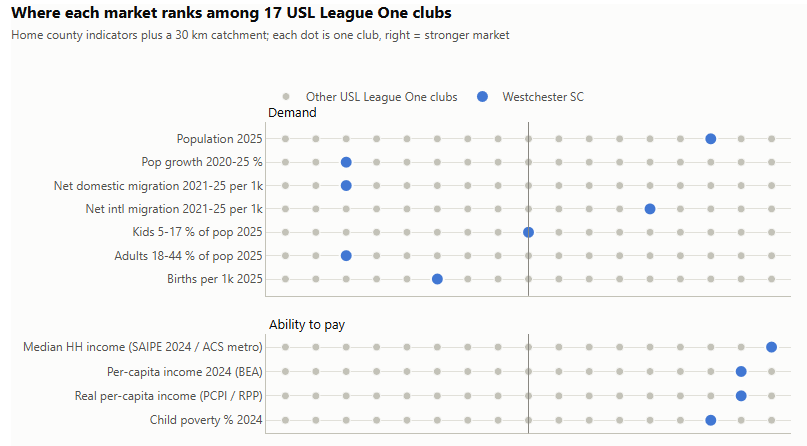
Westchester’s problem is almost the opposite of Corpus Christi’s. The market ranks first or second in USL League One across every major income measure, even after accounting for local prices that are roughly 13% above the national average. It also has a relatively deep base of potential sponsors, sports businesses, and higher-income households. The immediate ability to pay for tickets or support the club commercially should not be the limiting factor. However, the underlying economic trends are less encouraging than those headline income figures suggest. Employment growth over the last five years has been close to zero, while recent wage growth ranks 16th among the league’s 17 markets.
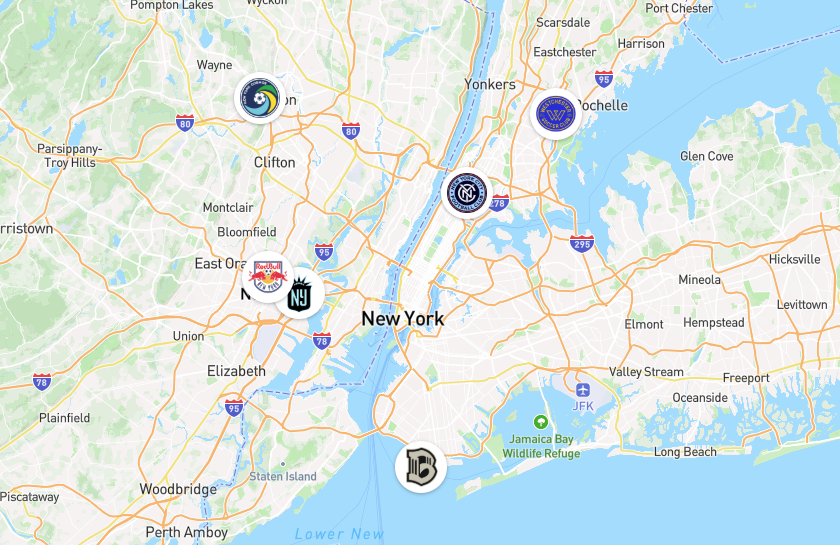
The larger problem may be how contested the local fan base has become. NYCFC, the New York Red Bulls, the New York Cosmos, and Brooklyn FC all play within 50 kilometers (image above shows NYC-based clubs in the top 3 tiers), giving soccer supporters several alternatives across multiple levels of the professional game. Westchester has roughly 10 million people living within 30 kilometers, but that population has translated into fewer spectators per match than the much smaller Boise market. The comparison illustrates why total population can be misleading in a dense metropolitan area: Westchester has access to an enormous number of people, but it does not have exclusive access to their attention, spending, or soccer loyalties.
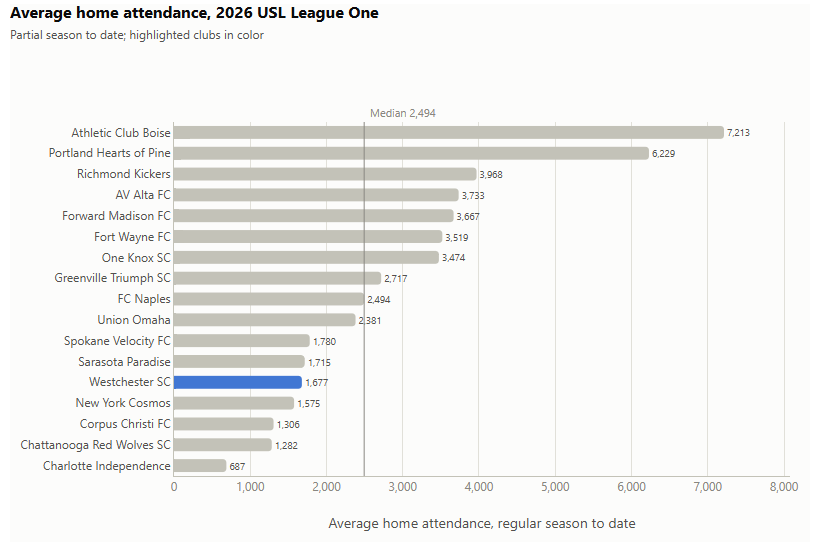
Local demographic and operating conditions add to the challenge. The county’s population is roughly flat, it has the league’s largest net outflow of income per resident, and new-home construction is the lowest among League One markets. Its population also skews older, ranking 15th in the share of adults aged 18 to 44, a group that would normally form an important part of a lower-division club’s audience. Some of Westchester’s struggles are even more direct. The club finished last in its inaugural season and plays in the league’s smallest stadium, with a capacity of just 3,900. Average attendance has reached only 1,677 this year, fifth-lowest in the league and well below the median of 2,494. Westchester may have plenty of potential spending power, but its stagnant local economy, older demographics, crowded sports market, and limited matchday footprint have made that spending power difficult to capture.
It is disappointing to see two relatively new clubs reportedly preparing to fold, but short-lived teams remain an unfortunate feature of the U.S. soccer ecosystem. USL League One is an especially difficult level at which to build a sustainable operation, with third-tier clubs facing limited media revenue, modest attendance, and a heavy dependence on local sponsors and committed ownership. Even so, the reports about Corpus Christi and Westchester do not necessarily point toward broader contraction across the league. USL said in June 2026 that four additional clubs were in the pipeline for the 2027 season. If those expansion plans materialize, League One would still emerge with more clubs on balance, even after losing these two. The league may continue to grow, but the experiences of Corpus Christi and Westchester show that national expansion does not make every individual market viable.
Click here if you would prefer to read or subscribe on Substack.