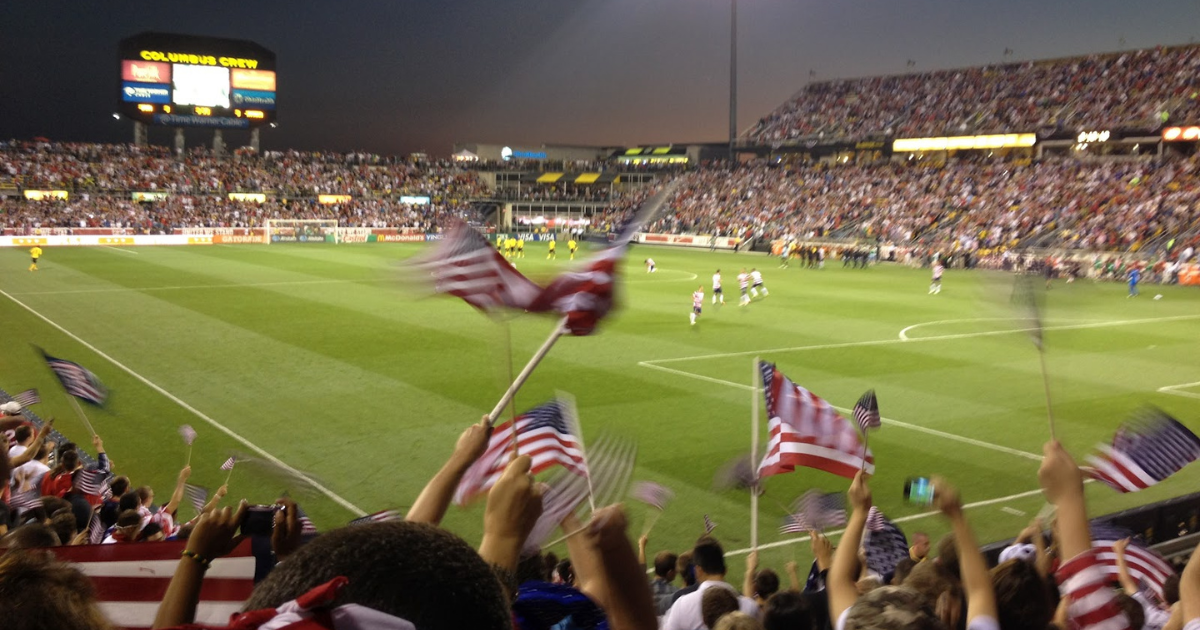
Last week, Nielsen released new data showing that the number of Americans who identify as soccer fans grew from 66.8 million in July 2025 to 75.2 million in July 2026, a 13% increase that MLS was quick to credit to this summer's World Cup. It is the latest in a long line of reports, polls, and press releases claiming that the tournament has changed soccer's standing in the US. Television networks have announced record audiences, leagues have touted surging ticket sales, and pollsters have found more Americans than ever calling themselves soccer fans. Taken together, the picture looks overwhelmingly positive, but these reports measure very different things, come from sources with very different incentives, and were mostly collected within a few weeks of the final on July 19.
That makes it worth stepping back and looking at all of the reporting together. Three months after the final, the evidence that the World Cup captured Americans' attention is about as strong as it could be. The evidence that it changed how Americans actually engage with the sport, whether by buying tickets, watching club soccer, or signing up to play, is much thinner, and in some areas it does not exist yet. Below is a look at what each body of reporting shows, where it is strongest, and what still needs to be measured before anyone can say the World Cup bump is real.
Fandom and Polling
Every major poll taken around the tournament shows soccer fandom moving in the same direction, but how large the increase looks depends heavily on how each one defines a fan. At the low end, Gallup found that 9% of Americans now name soccer as their favorite sport to watch, the highest figure it has ever recorded. At the high end, a Morning Consult poll for Bloomberg found that 46% of adults are willing to call themselves soccer fans, up 10 points from a similar poll taken just before the tournament.
| Source | What it measures | Before | After |
|---|---|---|---|
| Morning Consult for Bloomberg | Adults who call themselves soccer fans | 36% (May) | 46% (Sept.) |
| SSRS Sports Poll | Adults who are fans of pro soccer | 44% (prior 12 months) | 49% (June) |
| Nielsen Fan Insights | Self-identified soccer fans | 66.8M (July 2025) | 75.2M (July 2026) |
| Gallup | Soccer as favorite sport to watch | 7% (previous high) | 9% (Aug.) |
| Ipsos for AP | Say they personally got more into soccer | - | 24% (June) |
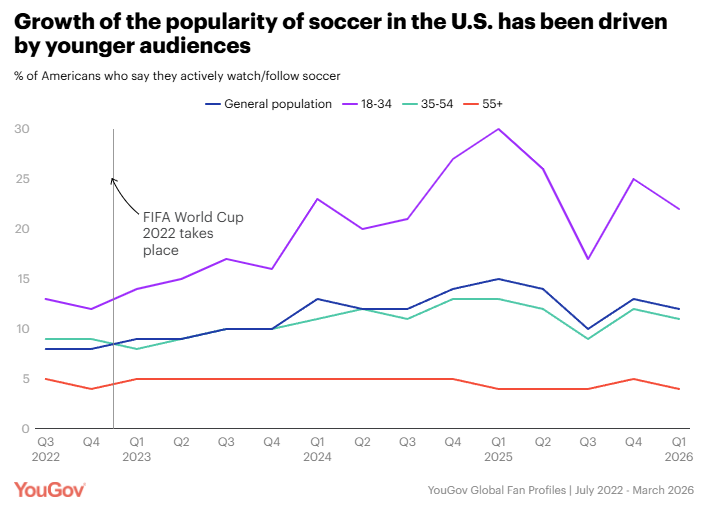
| YouGov SportsIndex | Actively follow soccer | 8% (mid-2022) | 12% (early 2026) |
The Morning Consult numbers are probably the most useful of the group, because the same question was asked of roughly 2,000 adults in late May and again in mid-September, about eight weeks after the final. The increase was largest among Gen Z, which rose 16 points, and 61% of Gen Z respondents now identify as at least casual soccer fans (via Briefs). That lines up with YouGov's SportsIndex, which showed the share of 18-to-34-year-olds who actively follow soccer climbing from 13% to 22% between 2022 and early 2026, before a ball was even kicked. Nielsen's 75.2 million figure points the same way, although Nielsen sells its data to the leagues and broadcasters that benefit from a growth story, and its comparison is a July snapshot taken during the tournament itself.
The same polls also contain some less flattering details:
- Morning Consult found that 38% of adults did not follow the tournament at all, and a quarter of Baby Boomers said it made them less interested in soccer.
- An Ipsos poll for the AP, taken near the end of the group stage, found that about six in 10 adults expected other Americans to get more into soccer because of the World Cup, but only 24% said it had happened to them.
- Gallup was the most cautious of the group, noting that it cannot yet say whether soccer's 9% represents a new level or a temporary bump.
Gallup's long-term trend does offer some reassurance, though. Soccer never registered above 2% before 2005 and has now been at 5% or higher in each of Gallup's last three surveys.
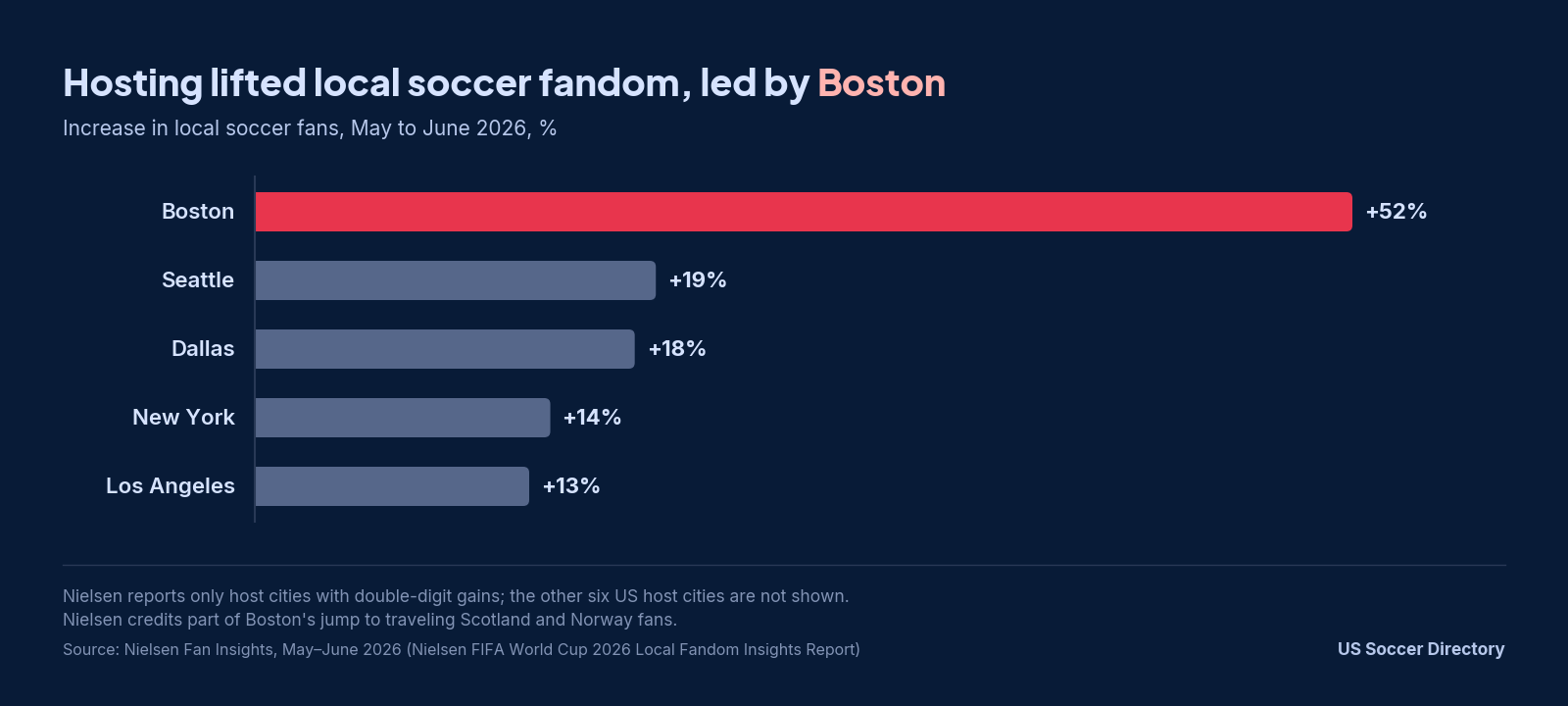
Hosting also appears to have mattered. Nielsen's local fandom report found double-digit increases in local soccer fans between May and June in five of the 11 US host cities, led by Boston at 52% (Nielsen).
Interestingly, the markets that watched the most were not all host cities. Seattle and Kansas City posted the highest average shares for USMNT matches, followed by Denver, the Bay Area, and Boston. Nielsen attributes Denver's and Kansas City's numbers in part to strong local MLS and NWSL cultures, and Kansas City's NWSL attendance index runs about 10 times the national average. That suggests existing club infrastructure may matter as much as proximity to a World Cup stadium, a theme that comes up again below.
TV Viewership
The tournament's television numbers are the least controversial part of this story. By almost any measure, the World Cup drew the largest US audiences soccer has ever had:
- The final between Spain and Argentina averaged 66.4 million US viewers according to Nielsen's final match-only count (Front Office Sports), or 62.8 million if you add Fox's 38.9 million to Telemundo and Peacock's 23.9 million (NBC Sports). Either way, it was the most-watched soccer match in US history and roughly three times the 22.3 million who watched the 2022 final.
- Fox averaged 7.74 million viewers across the tournament, up 116% from 2022, while Telemundo averaged 6.3 million, up 143%.
- Telemundo reported 77.2 billion minutes viewed, more than the 2018 and 2022 tournaments combined, with streaming making up 48% of its audience (NBCUniversal).
- The USMNT's round-of-16 loss to Belgium drew somewhere between 30.0 million and 33.1 million viewers depending on whose count you use, a record for an English-language soccer broadcast in the US (Sports Media Watch).
Those comparisons do come with a couple of caveats. The 2026 matches were played in US time zones, while the 2022 tournament in Qatar was played in November and December, with many matches during the US workday. Nielsen has also since moved to its Big Data + Panel methodology, which captures more out-of-home and smart TV viewing than the 2022 numbers did and tends to inflate year-over-year comparisons for live sports. Neither caveat changes the overall conclusion, but both mean the percentage gains likely overstate how much more interested Americans actually were.
The more important question is whether any of that audience carried over to club soccer once the tournament ended. Nielsen's post-tournament data suggests that it did, but mainly among younger viewers.
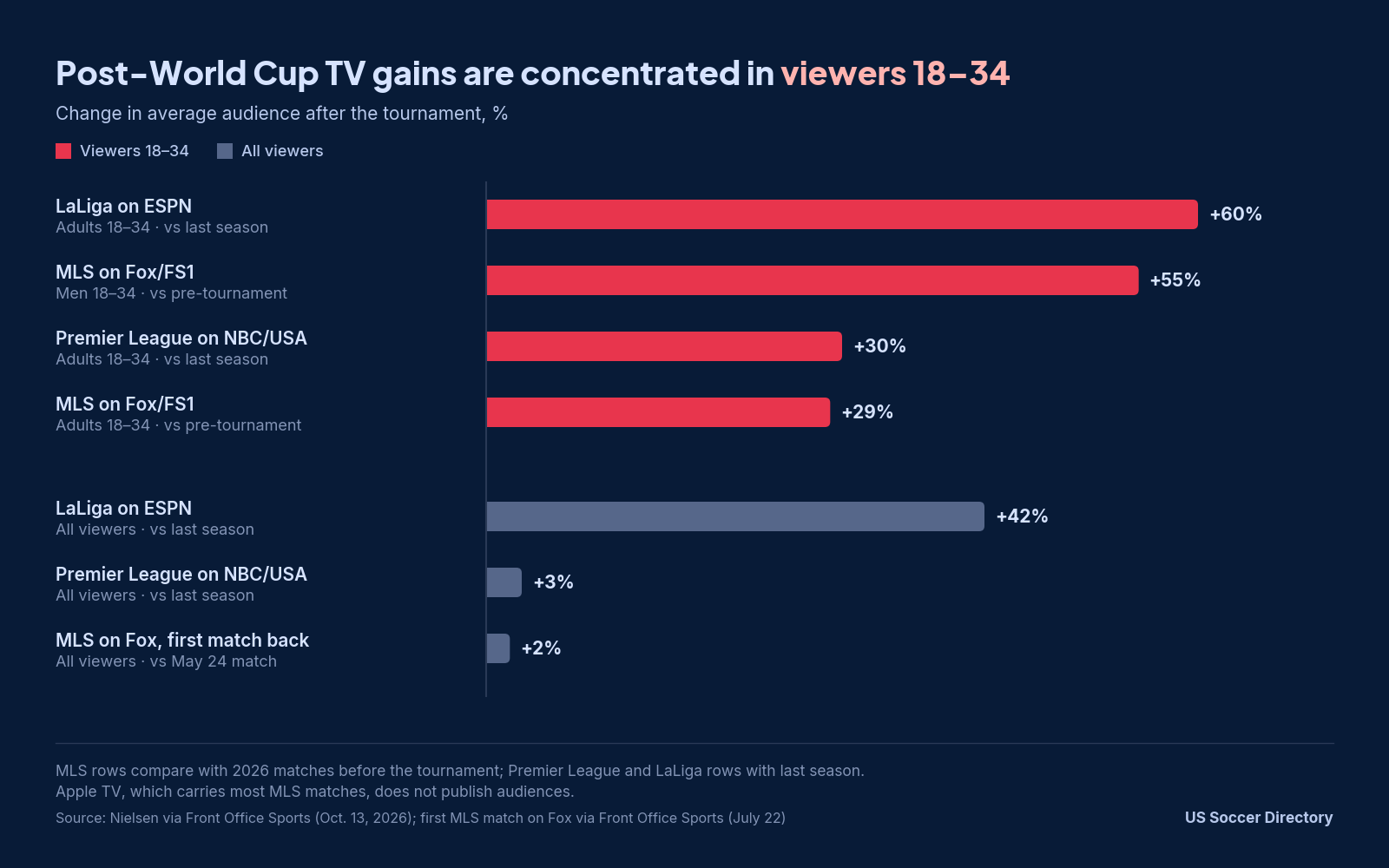
Among total audiences, the carryover looks much smaller. The first Fox MLS doubleheader after the tournament drew 587,000 viewers for its top match, compared with 578,000 for a comparable match in May, which Front Office Sports described as ratings staying "mostly flat" (Front Office Sports). The Premier League is up just 3% overall on NBC and USA Network, even as its 18-to-34 audience has grown. Nielsen has reported that young-adult gain two different ways, as 20% in an Oct. 5 release (Al Jazeera) and as 30% on Oct. 13 once Spanish-language broadcasts were included. Most MLS matches are also on Apple TV, which does not publish audience figures, so any claim about MLS viewership is really a claim about the small slice of matches on Fox and FS1.
Attendance and Ticket Sales
The clearest sign that the World Cup changed behavior, at least in the short term, has come from MLS ticket sales. MLS told Sports Illustrated that league-wide ticket sales rose 62% in the 40 days during and after the tournament compared with the 40 days before it, and several clubs reported even larger increases (Front Office Sports):
- The Philadelphia Union said single-game ticket sales were up 218% after the tournament began.
- Nashville SC reported a 161% increase in online ticket sales.
- The New England Revolution expected more than 30,000 fans for a Saturday match, well above its average of about 18,000.
- The MLS All-Star Game in Charlotte drew 35,197 fans just 10 days after the final, compared with roughly 20,800 in each of the two previous years (Sports Illustrated).
Admittedly, all of those figures come from the league or the clubs themselves, and there are reasons not to read too much into them. Ticket sales are not the same as attendance, and some of the demand came from free promotions, such as the more than 5,000 tickets the New York Red Bulls gave away to first-time attendees. MLS was also already drawing near-record crowds before the tournament, averaging 22,109 fans per match through May, the second-highest mark in league history (MLS). The All-Star Game jump also partly reflects a much larger stadium than the previous two editions. Several widely shared articles claim that MLS attendance is up 28% to 40% since the World Cup, but none of those figures can be traced to a league release, and they should be treated with a lot of skepticism.
The NWSL was riding its own momentum well before the World Cup. The league averaged 11,174 fans per match through early August, second only to its record 2024 season (Just Women's Sports), and a match between Gotham FC and the Washington Spirit sold roughly 42,000 tickets at Citi Field (AP). With that being said, nobody has published a comparison of NWSL viewership before and after the tournament, so it is hard to say how much of the league's growth is connected to the men's World Cup at all.
The USL is the biggest gap in the reporting. Going into the tournament, average attendance in the USL Championship was around 4,800 per match, down 11% from the year before (Backheeled). If the World Cup did have a meaningful effect on lower-division soccer, the second half of the USL season is where it should show up, but so far no outlet has looked.
Youth and Amateur Participation
There is currently no national data showing whether the World Cup has led more kids or adults to start playing soccer. U.S. Soccer, US Youth Soccer, AYSO, and US Club Soccer have not published registration numbers since the tournament, and the articles claiming a "record registration surge" mostly come from companies that sell registration software, none of which cite actual counts. The local reporting that does exist is encouraging. Some neighborhood programs in Fort Worth saw registrations rise during the tournament (Fort Worth Report), and Tucson's adult league passed 1,000 players and added 50-and-over and 60-and-over divisions (KOLD). Those are still individual stories, though, not evidence of a national trend.
Even once fall numbers are released, they will be difficult to interpret. US Youth Soccer, AYSO, and US Club Soccer moved from birth-year to school-year age groups for the 2026-27 season (NorCal Premier, SoccerWire), which means rosters were rebuilt across the country and this year's registration totals will not compare cleanly with last year's.
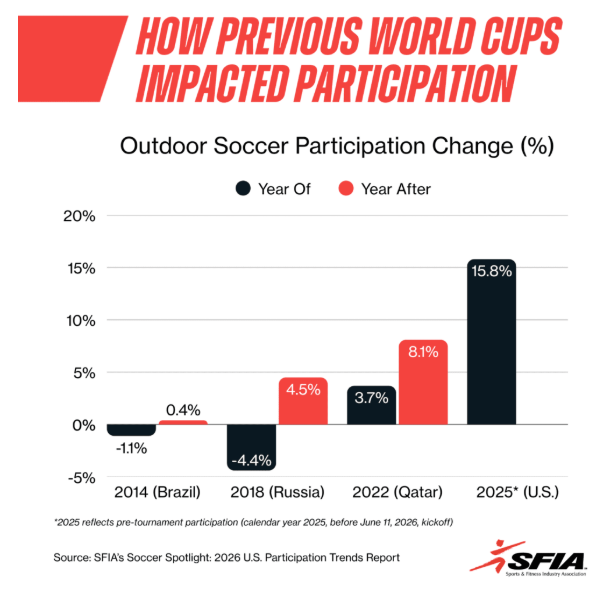
The best baseline comes from the Sports & Fitness Industry Association, which found that 16.8 million Americans played outdoor soccer in 2025, a record and a 15.8% increase from 2024 (SFIA). History suggests that any World Cup effect on participation tends to show up the following year rather than during the tournament itself:
- After 2014, outdoor participation actually fell 1.1%, even as Google searches for soccer peaked.
- After 2018, when the USMNT failed to qualify, it dropped 4.4%.
- After 2022, gains were modest during the winter tournament, but participation rose 8.1% in 2023.
SFIA's data also shows that recent growth has come largely from casual players, adults, Hispanic Americans, and women, much of which would not show up in youth registration numbers at all.
There are also signs that the bigger constraint may be access rather than interest. Aspen Institute's Project Play mapped youth soccer in New York City and North Jersey ahead of the tournament and found roughly 150,000 kids who want to play but don't, compared with about 250,000 who already do (State of Soccer). Team fees were a barrier for 32% of players and 41% of players from low-income families, and the report identified parts of Newark and the South Bronx as "soccer deserts" with strong interest but few fields.
Host city legacy programs are trying to address that gap, mostly through U.S. Soccer Foundation mini-pitches:
- Boston committed to building up to 20 mini-pitches (U.S. Soccer Foundation).
- Philadelphia committed to 10 as part of a $2 million program (U.S. Soccer Foundation).
- Houston committed to 30 through a $6 million campaign (Inside World Football).
Those are targets announced by the organizations building them rather than completed projects, and compared with 150,000 unserved kids in a single metro area, they are relatively small.
Economic Impact
The economic reporting is a bit outside the scope of fandom, but it does say something about how Americans experienced the tournament. Bank of America's card data found that spending in host cities rose about 5% year over year during the tournament, with spending by non-locals up more than 17% and Kansas City posting the largest gain at 7% (Bank of America Institute). Restaurants and bars were the biggest winners. However, the bank described the effect on national GDP as "more modest," in large part because spending appears to have shifted from non-host cities to host cities rather than increasing overall.
The tourism side was more mixed:
- HVS estimates that host city hotels earned about $680 million in additional room revenue during match weeks, short of Tourism Economics' forecast of roughly $900 million, and most of that gain came from higher prices rather than more guests (Hospitality ON).
- Houston's hotel demand actually fell during six of the seven matches it hosted, and Los Angeles also underperformed.
- FIFA reported 9.02 million visits to its Fan Festivals across all 13 host cities, the most since 2006, but did not publish a US-only figure (FIFA). Philadelphia's free fan festival alone drew about 575,000 people over 39 days (Front Office Sports).
Betting and merchandise tell a similar story of strong anecdotes without complete data. The final was the most-bet soccer match ever at BetMGM, Caesars, and DraftKings, and Hard Rock described tournament betting as the equivalent of "10 Super Bowls" (ESPN), but the only full-tournament handle figures are pre-tournament projections of $2.3 billion to $4.3 billion (Covers). Circana reported triple-digit growth in sales of FIFA-licensed gear in the run-up to the tournament (SGB), but no one has reported sales figures from after it. Taken together, the economic data points to a World Cup that was experienced locally, in bars and at watch parties, more than through tourism, which may actually be the more meaningful signal for long-term fandom.
Will It Last?
The biggest open question is whether any of this growth will stick, and right now the data simply cannot answer it. Previous World Cups have produced large spikes in interest that faded quickly. A Google Trends analysis found that US search interest in soccer reached a 20-year high during this tournament, but in past cycles interest lost about half of its momentum within four to eight weeks of the final and returned to normal within about six months (Stacker). Nearly all of the "after" measurements discussed above were taken inside that window.
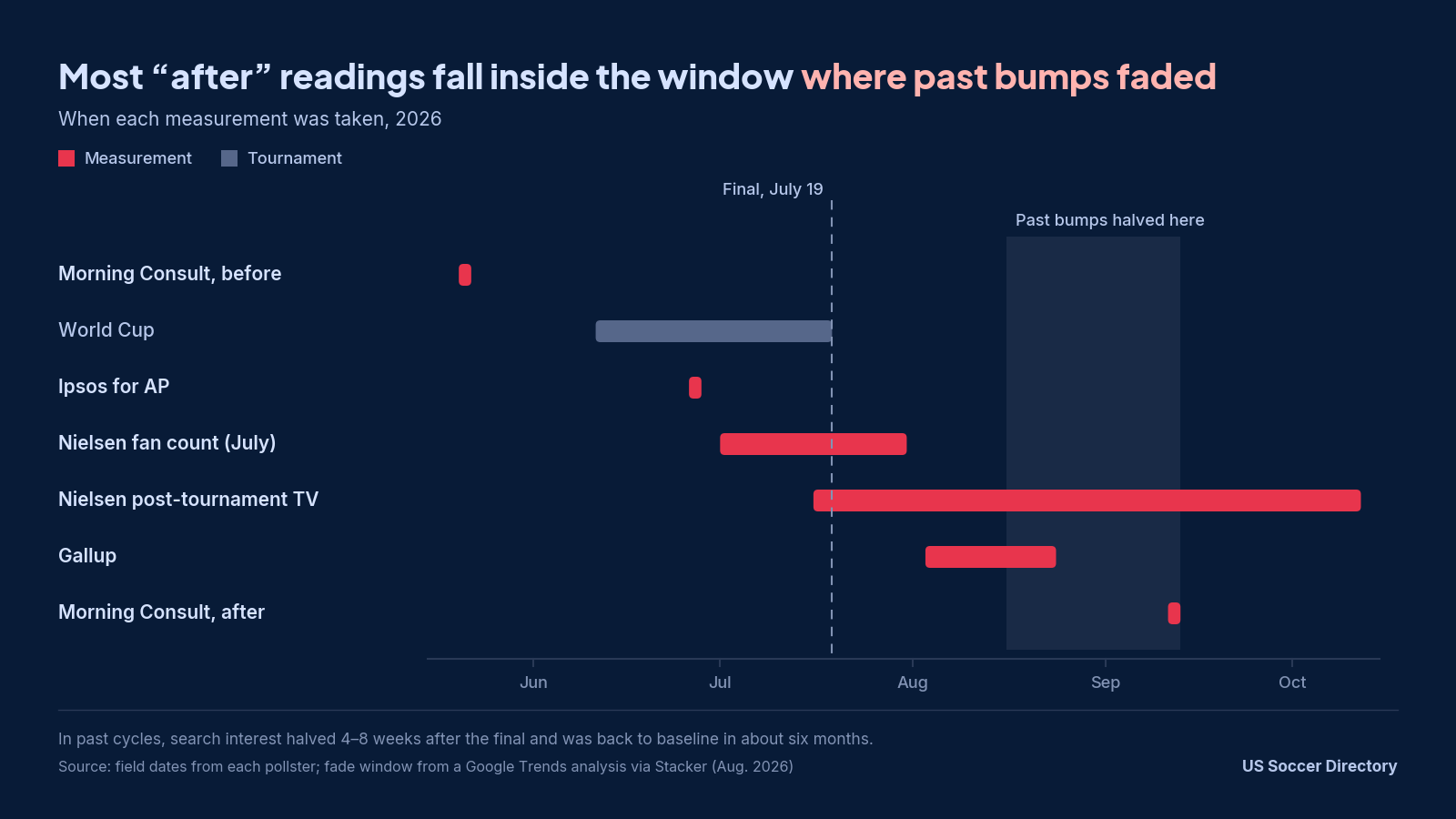
Nielsen's fan count is a July snapshot taken during the tournament itself, and Gallup was in the field two to five weeks after the final. Only the second wave of Morning Consult's poll, taken eight weeks after the final, reaches the end of the period when previous bumps faded, and it still showed a 10-point increase. That is an encouraging sign, but it is one data point.
There are some reasons to think 2026 could hold up better than past tournaments:
- Unlike 2014 or 2022, matches were played in US time zones, on free TV in English and Spanish, and in person in 11 US metro areas.
- The domestic game is in a much different place than it was in 1994, when MLS did not exist yet. There are now 30 MLS clubs, an NWSL drawing near-record crowds, and more than 100 USL clubs across its professional and pre-professional leagues, giving new fans somewhere to go after the tournament ends.
Columbia Business School's Jonathan Sperling has argued that the long-term effect will depend on whether that ecosystem can keep new fans engaged (Stacker). It is also worth remembering that YouGov, SFIA, and MLS all showed meaningful growth before the tournament started, so some of what is being described as a World Cup effect is likely a trend that was already underway.
How Strong Is the Evidence?
| Claim | Evidence |
|---|---|
| The World Cup drew record US audiences | Strong |
| More Americans now call themselves soccer fans | Strong |
| The growth is concentrated among young adults | Moderate |
| More people are buying tickets to MLS matches | Moderate |
| Host cities got an economic boost | Moderate |
| More people are watching club soccer on TV | Weak |
| The bump is lasting | Weak |
| More people are playing soccer | Unmeasured |
The two strongest claims are about attention and identity. The record audiences are backed by Nielsen and by both rights holders, and while changes in measurement inflate the comparisons, no one really disputes the result. The increase in people calling themselves fans shows up in every independent poll, including Gallup, Morning Consult, SSRS, and YouGov, even if the size of the increase varies quite a bit from one to the next.
The moderate claims have real evidence behind them but rely on narrower or less independent sources. The concentration among young adults shows up in both Morning Consult's polling and Nielsen's TV data. The ticket sales figures come entirely from MLS and its clubs, and Bank of America's spending data, while independent, describes a shift in where money was spent more than an increase in total spending.
The weak claims are the ones that would matter most for the long-term health of the sport. Total TV audiences for club soccer have barely moved outside of LaLiga, and the only evidence that the bump is lasting is a single poll taken eight weeks after the final. As for participation, there is no national data at all yet, only local reports and claims from software vendors.
What to Watch
Most of the data that could settle these questions will arrive between now and the spring of 2027. A few things worth watching:
- USL attendance after the World Cup. The USL Championship regular season ends Oct. 24, and comparing each club's attendance before and after July 19, especially in host markets versus non-host markets, would help answer a question no one has really looked at yet.
- Full-season MLS and NWSL attendance. Final attendance numbers will show whether the summer spike in ticket sales actually turned into larger crowds.
- Fall registration numbers. Any figures from US Youth Soccer, AYSO, and US Club Soccer will need to be read with the age group change in mind.
- SFIA's 2026 participation report. Expected in early 2027, this is where a World Cup effect on participation would most likely show up first, if the pattern after 2022 holds.
- Another round of fandom polling. A poll taken around January 2027, roughly six months after the final, would show whether this bump fades the way past ones have.
- Apple TV viewership. Until Apple publishes audience numbers for its MLS broadcasts, claims about MLS viewership will only cover the matches on Fox and FS1.
For now, the reporting supports a fairly simple conclusion. The World Cup gave US soccer the largest audience it has ever had and appears to have convinced millions of Americans to start thinking of themselves as fans. Whether those new fans buy tickets, keep watching, or pick up the sport themselves is a question that the next six months of data should start to answer.
Click here if you would prefer to read or subscribe on Substack.
Sources
Fandom and Polling
- Nielsen FIFA World Cup 2026 Local Fandom Insights Report
- Nielsen: American soccer fandom soars after 2026 FIFA World Cup (MLS)
- Nielsen: post-World Cup soccer audiences surge among young viewers (Front Office Sports, Oct 13)
- US soccer fans surge after World Cup, surpassing NHL (Bloomberg, Oct 1), via Briefs
- Football still top US sport, soccer inching up (Gallup)
- Pro soccer gains 15 million American fans in June (SSRS)
- Soccer fans are into this year's World Cup, but the US still isn't a soccer nation (AP, Ipsos poll)
- Soccer is gaining ground in the US ahead of the FIFA World Cup (YouGov)
TV Viewership
- World Cup final viewership (Front Office Sports)
- More than 62 million US viewers watched 2026 World Cup final (NBC Sports)
- Telemundo and Peacock redefine soccer fandom in the US (NBCUniversal)
- USMNT World Cup viewership record in Belgium loss (Sports Media Watch)
- Premier League viewership in US up 20 percent among young Americans (Al Jazeera)
Attendance and Ticket Sales
- World Cup ignites MLS ticket sales, but ratings stay mostly flat (Front Office Sports, July 22)
- MLS promises to be the cure for post-World Cup blues (Sports Illustrated, July 30)
- MLS viewership up more than 62% in 2026 (MLS)
- NWSL attendance milestone (Just Women's Sports)
- NWSL eyes World Cup, Olympics in next era of growth (AP via News Tribune)
- USL attendance is falling (Backheeled, July 2)
Youth and Amateur Participation
- Soccer participation in the US hits an all-time high ahead of World Cup (SFIA)
- State of Soccer: NYC and Northern New Jersey (Aspen Institute Project Play)
- World Cup got more Fort Worth kids playing soccer (Fort Worth Report)
- US World Cup run fueling soccer participation surge in Tucson (KOLD)
- Age group changes for 2026–27 (NorCal Premier) and background (SoccerWire)
- U.S. Soccer Foundation legacy announcements: Boston, Philadelphia, Houston
Economic Impact
- On the ball: World Cup 2026 final score (Bank of America Institute)
- 2026 World Cup hospitality review (Hospitality ON)
- Fan Festival record attendance (FIFA)
- World Cup betting in US equivalent of "10 Super Bowls" (ESPN)
- EKG projects $2.82B World Cup betting handle (Covers)
- Circana exec predicts major retail payoff from World Cup (SGB)
Will It Last?